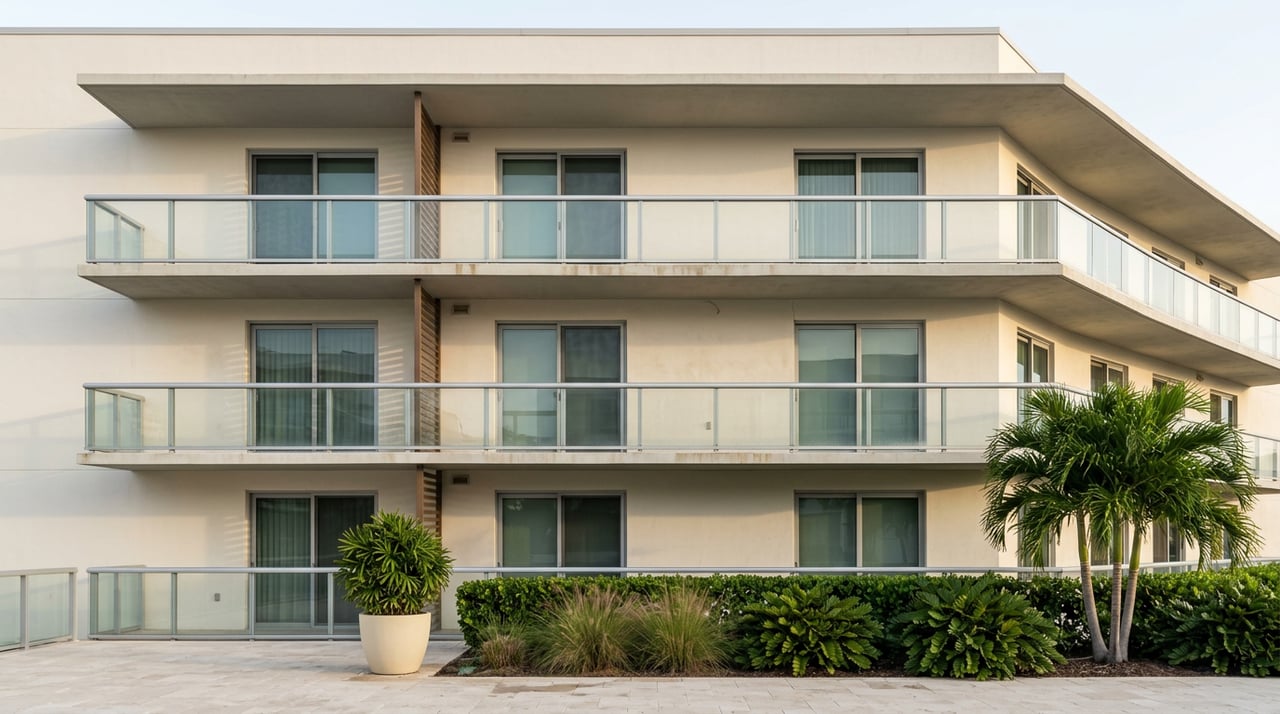
Why The Building's Age Decides Your Mortgage Before The Bank Does In Sarasota's Condo Corridor
August 20, 2026
August 20, 2026
A buyer I worked with this spring found a two-bedroom unit at 1350 Main Street with a straight bay view and a price that made sense for the finishes. She went under contract, ordered her appraisal, and assumed the rest was paperwork. Then her lender ran the building through Fannie Mae's Condo Project Manager and came back with a word she had never heard applied to real estate before: non-warrantable. The unit was fine. The building's reserve funding was not, and under the rules that took effect this year, that gap was enough to knock her conventional loan off the table entirely.
That story is becoming common across downtown Sarasota's condo corridor, and it points to something buyers researching this market rarely see coming. The gap between a $700 and a $1,000 price per square foot gets all the attention. The gap that actually decides whether you can finance the unit at all is quieter, and it runs along a line nobody prints on a listing sheet: the building's certificate of occupancy date.
Florida's condo safety law requires a structural milestone inspection once a building turns 30, or 25 if it sits within three miles of the coast. Almost the entire downtown Sarasota corridor, from the Quay to Golden Gate Point to the bayfront tower spine along Palm Avenue and Ringling Boulevard, falls inside that three mile line. That means the 25 year trigger applies, not the 30 year one, and it applies to nearly every condo association in the 34236 zip code.
Here is the part that changes how you should shop. That 25 year clock starts on the day the certificate of occupancy is issued. A brand new tower does not just deliver nicer finishes. It resets the compliance clock to zero. The Ritz-Carlton Residences at Sarasota Bay, delivering late 2026 with 78 residences across 20 stories at The Quay, will not face a milestone inspection or a Structural Integrity Reserve Study until roughly 2051. The same is true for One Park, delivering in early 2027 in the $3 to $6 million range, and for The Edge at 290 Cocoanut, a 10 story, 27 unit tower expected to complete in mid to late 2026. Mira Mar's two 18 story towers on South Palm Avenue, SOTA Residences at 1703 Main Street, The Palm 625, and the Waldorf Astoria Residences, which broke ground in spring 2027 for a 2029 delivery, all start that same 25 year countdown from scratch.
Meanwhile, many of the established towers that give downtown its skyline, buildings like Vue Sarasota Bay, The Tower Residences, and the historic Renaissance, were built decades ago and are already inside or approaching that inspection cycle. Their associations are working through milestone reports and reserve studies right now, at the exact moment the federal rules governing whether a mortgage can even be written on their units just got measurably harder to satisfy.
Florida's 2022 condo safety statute forced associations to stop waiving reserve contributions and start funding a real Structural Integrity Reserve Study. That was the first shock. The second, quieter one landed from Washington, not Tallahassee. On March 18, 2026, Fannie Mae released Lender Letter LL-2026-03, and Freddie Mac followed with matching guidance. Three changes in that letter matter more to a downtown Sarasota buyer than anything printed in a listing description.
First, the minimum reserve allocation is rising from 10 percent to 15 percent of an association's annual budgeted assessment income, phasing in fully by January 4, 2027. An association that has always funded reserves at the old floor now has to find more money, and if it does not have a current, qualified reserve study to lean on instead, the building can fail the test outright.
Second, Limited Review, the lighter-touch financial check lenders used for established buildings, has been retired. As of August 3, 2026, applications now default to Full Review, meaning every association's books get the same level of scrutiny a brand new project would face. That deadline passed two weeks ago as of this writing, so the buildings currently under contract in this corridor are the first wave to feel it.
Third, starting with loan applications dated July 1, 2026 or later, a condo association's master insurance policy cannot carry a per-unit wind deductible above $50,000 without triggering a warrantability problem on its own. Coastal buildings that raised their deductibles to control premiums after recent hurricane seasons may now be tripping this rule even if their reserves are otherwise fine.
None of this touches the unit. It touches the association, and it touches every buyer trying to finance inside that association's walls.
Downtown Sarasota isn't one condo market. It separates into five distinct clusters, and each one carries a different relationship to the compliance clock.
| Cluster | Building age profile | Where it sits on the clock |
|---|---|---|
| The Quay / Boulevard of the Arts | Newest pre-construction and recent deliveries: Bayso, Ritz-Carlton Residences, One Park, 1000 Boulevard of the Arts | Clock resets at CO; largely insulated from milestone/SIRS review for decades |
| Bayfront-Tamiami tower spine | Established towers along Palm Avenue and Ringling Boulevard, including Vue Sarasota Bay and The Tower Residences | Inside or entering the current inspection cycle now |
| Main Street / Palm Avenue walkable | Mix of historic mid-rises like 1350 Main Street and The Renaissance alongside new projects like SOTA and The High Line | Split, older buildings under active review, new towers exempt |
| Rosemary District | Rapidly redeveloping block with new mid-rise and boutique product | Mostly new construction, favorable clock position |
| Burns Court / Laurel Park | Boutique, low-rise, historic character | Older stock, cycle status varies building to building |
A buyer comparing two units at similar price points in the Main Street cluster could be choosing between a building that just cleared its SIRS with healthy reserves and one still working through a special assessment discussion. The listing photos will not tell you which is which.
For years, this corridor's cash-heavy buyer pool covered for a lot of these problems. Back in February 2026, cash accounted for 68 percent of Sarasota County condo and townhome closings countywide, according to RASM's monthly statistics, compared to 47 percent for single-family homes. A buyer who doesn't need a mortgage never has to hear the word non-warrantable.
That cushion has been thinning through the summer. Weekly county reports through late July and early August 2026 have shown cash making up closer to 35 to 47 percent of all closings, a noticeably smaller share than the winter figures. As more of this year's buyers arrive needing a loan rather than writing a check, they are running headfirst into a warrantability standard that just got stricter at the same moment they need it to be lenient.
If a building fails warrantability, the loan does not disappear, but it moves. Conventional financing through Fannie Mae or Freddie Mac is off the table, and the buyer shifts into portfolio or non-QM lending. Current lender matrices reviewed this spring commonly cap loan-to-value on non-warrantable condos around 70 to 80 percent, meaning a down payment closer to 20 to 30 percent instead of the 10 to 20 percent a conventional buyer might plan for. Rates run higher too. FHA and VA financing is rarely an option once a building fails the conventional standard, since those programs maintain their own separate approval lists.
For a seller, this cuts the other direction. A building that has already cleared its Structural Integrity Reserve Study and milestone inspection, and that funds reserves above the new 15 percent floor, is handing every future buyer a wider financing pool. That is a real advantage in a market where condos are already taking longer to sell than single-family homes, with recent weekly data through early August 2026 showing condos averaging around 118 days on market countywide against roughly 72 days for single-family homes.
Before writing an offer in this corridor, a buyer should ask for three things beyond the standard document packet:
Does a new building's warrantable status mean it will never face a special assessment? No. It means the building has decades before the state's inspection and reserve requirements apply. Construction defects, insurance repricing, or association mismanagement can still create costs. It simply removes one specific and currently active source of financing risk.
Can an older building fix a non-warrantable status? Often, yes. A reserve shortfall can be corrected with a funding plan and a current study. Litigation or a documented safety issue takes longer to resolve. The fix depends entirely on which rule the building failed.
Should I avoid older buildings entirely? Not necessarily. A building that has already completed its SIRS, passed its milestone inspection, and funds reserves above the new floor is often a safer bet than an unreviewed new project still working through its first year of association finances. The clock position matters, but so does what the association has actually done with the time it's had.
If you're comparing units across the Quay, the Rosemary District, or the established bayfront towers along Palm Avenue and want a straight answer on where a specific building sits on this timeline before you write an offer, that's exactly the kind of groundwork A Classic Approach does before a client ever signs a contract. Schedule a Free Market Consultation and we'll walk through the compliance status of any building you're considering.
Stay up to date on the latest real estate trends.
It's that appreciation for classically high standards that make me an ideal real estate professional to help you with your home sale or purchase in Sarasota and surrounding areas. I can help you with all your real estate needs, you get A Classic Approach with winning results. Call me today!